

The City of Cape Town has launched an online eHeritage platform to strengthen efforts, preserve and share the rich history through new digitisation technology. The development of an innovative online platform is work of a dedicated team of professionals and interns who are making thousands of invaluable historical records more accessible to the residents.
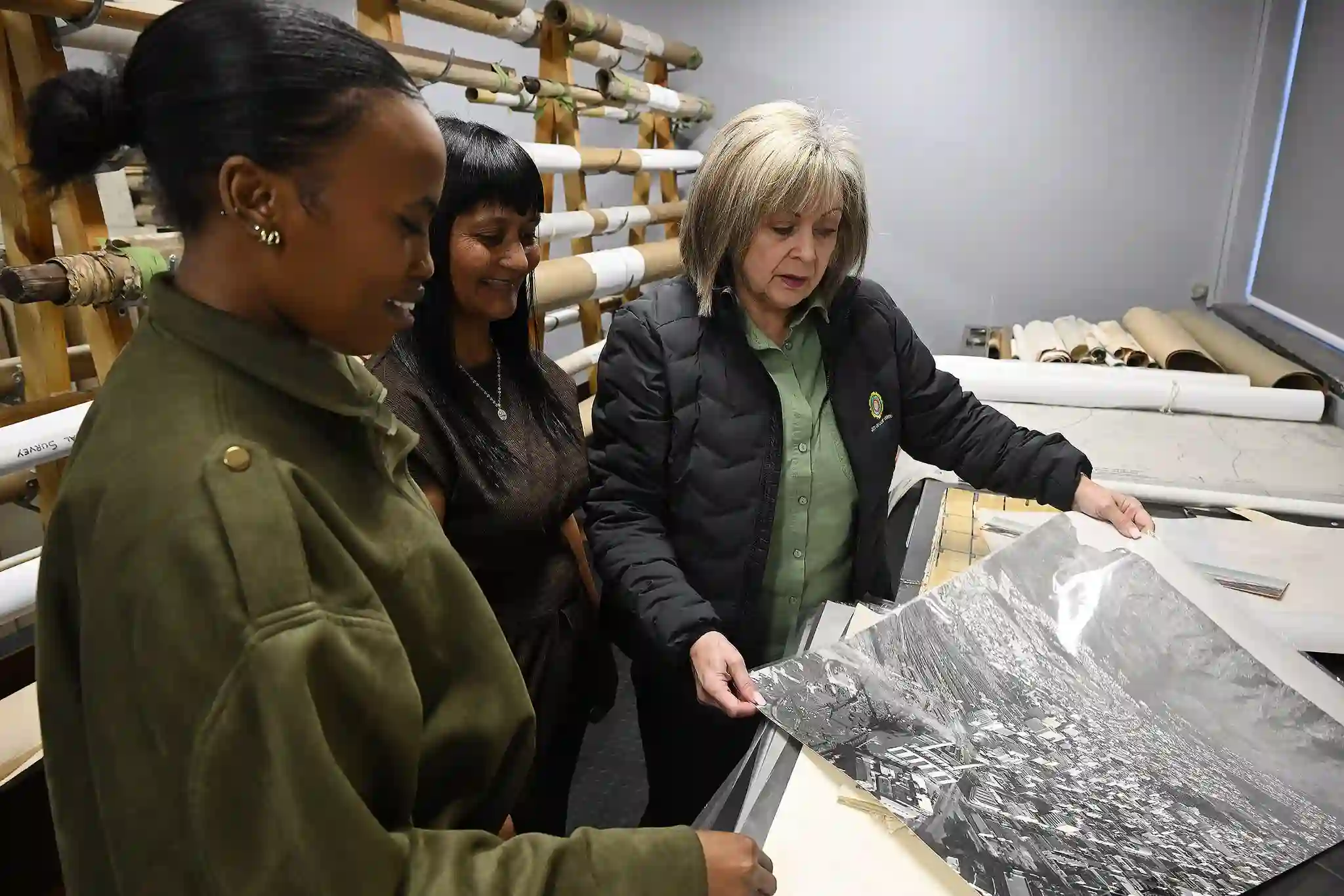
Member of the Mayoral Committee for Corporate Services – Alderman Theresa Uys visited the Environmental Heritage Resources Information Centre (EHRIC) at 44 Wale Street this week to witness the remarkable work being undertaken behind the scenes.
Considering this Alderman Uys stated that the last time she visited the City of Cape Town’s Environmental Heritage Resources Information Centre on Wale Street, then it was undergoing through repairs following storm damage.
She said that she is pleased to see that the map room now has new shelving and enhanced protection for the valuable documents entrusted to the City’s care. It was also a pleasure for her to meet the interns who have been placed in this office to assist with the scanning and classification of historical documents. She wished them to grow and learn through this experience.
Alderman Uys further stated that she was obliged to meet Khanyiswa Mahambehlala, who came through the Corporate Services internship programme and since then has secured a permanent position with the City of Cape Town.
As the City of Hope, they welcome every opportunity to place interns within the organisation, and she thanked the Human Resources Department for facilitating these opportunities across the workforce of over 33,000 employees.
Digitising Yellow Pages
As per the sources, four interns joined Environmental Management earlier this year to support the digitisation of historical documents, which were:
- Sinazo Dyonase (28) from Nyanga
- Yusrah Alcock (28) from Athlone
- Ziyanda Mngati (30) from Mfuleni
- Loenora Hendricks (42) from Bishop Lavis
Now the interns are working alongside the appointed clerk Khanyiswa Mahambehlala. Their catalogue consists of historical material, capture information on the City of Cape Town’s heritage databases, digitise historical Property Valuation Records known as the ‘Yellow Pages’, and assist with scanning historical building plans and archival documents. The visit also highlighted significant investment in technology to accelerate the preservation of Cape Town’s documentary heritage.
Preserving Rich Heritage
The City of Cape Town has recently acquired two specialised scanners to support the digitisation programme. A Bookeye-5 book scanner is being used to digitise fragile historical books, bound volumes and the City’s extensive collection of newspaper clippings dating back to the late nineteenth century. A second scanner, the ROWE large-format roller scanner, enables the high-quality digitisation of historical building plans, maps and oversized archival documents.
Senior Heritage Professional at EHRIC of the City of Cape Town – Willem Hutten stated that Cape Town has a rich heritage. Part of this heritage is a remarkable collection of historical maps, surveys, plans and photographs that form part of the Environmental Heritage Resources Information Centre.
Hutten added that the map collection includes the work of William Barclay Snow (1862), Alexander Wilson (1878) and Walter Thom (1898). While access to many original documents is necessarily restricted because of their age, size and fragile condition, many of their historical maps are already available to the public through the CityMap Viewer.
Advance eHeritage Information Management System
The City of Cape Town is also developing an eHeritage Information Management System, which is expected to be fully accessible to the public by July 2027. Through eHeritage, additional heritage information, including old photographs, research reports, building plans, declaration notices and other historical records, will become available to both City staff and members of the public.
The Environmental Heritage Resources Information Centre serves as the custodian of one of Cape Town’s most significant documentary collections, including original surveys, historical maps, mayoral minutes, building plans and newspaper archives that collectively tell the story of the city’s development made in these160 years.