
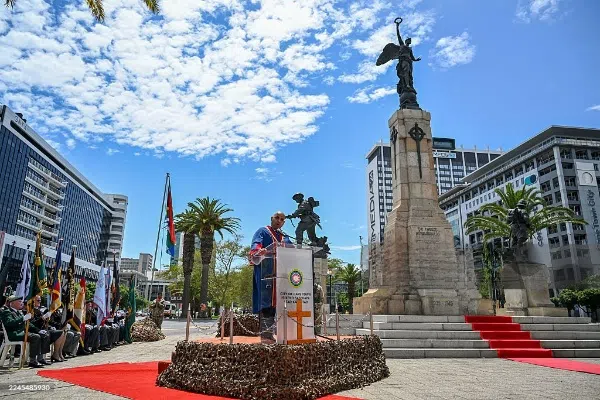

In Cape Town, the residents experience freedom in practice where there is no wastage of public funds. They encourage focused efforts on getting the basics done, regular maintenance of the assets, forward planning on meeting the need for affordable housing and Integrated Human Settlements, and record investment in infrastructure.
As, the Acting Mayor Eddie Andrews addressed the Council, he stated that “the promise of freedom” is not measured in history. It is measured in whether that freedom is upheld by capable institutions, accountable leadership, and outcomes that people can see and feel.
And just days after Freedom Day, that is the standard Capetonians must hold themselves to.
Andrews said that as he stands here in City Hall, he is acutely aware that this is a space that, not too long ago, was never meant for people like him. A place where decisions were taken about them without them. A place that once stood as a symbol of exclusion.
And yet today, he is standing here freely in the Nelson Mandela Exhibition. Andrews expressed that the Freedom Day is not only a date on the calendar, but a responsibility on all of them.
“What does freedom look like today? Is it safe in our communities? Is it a job that sustains families? Is it a roof over your head? Or is it clean water, working infrastructure, and a government you can trust?” asked Eddie Andrews
He answered these questions honestly and said that they must confront what is unfolding across the country, where cities like Johannesburg are struggling to provide reliable water, and where too many residents are without basic services.
He outlined, “Madam Speaker, Cape Town is different. We have remained disciplined in the fundamentals: We appoint principled and capable councillors, who uphold the duties, standards, and public trust of their office. We invest in infrastructure. We maintain what we build and we plan ahead.”
“Freedom is also about memory, about who we choose to honour, and how we recognise the histories that have shaped our city,” quoted Andrews.
The Naming Committee is considering a number of proposals, and among these are two that will come before Council; mainly each carrying particular significance for the diverse city.
Firstly; the proposed renaming of Belhar Drive to John van der Rheede Drive. This is a recognition of a man whose life was defined by service, an educator, a community organiser, and a civic leader who worked across decades to uplift communities. This re-naming ensures that his contribution is not only acknowledged but permanently embedded in the fabric of the community he served.
Secondly; the proposed renaming of Ben Friedman Square to Strand Muslim Square. This is a decision grounded in both history and reconciliation. Ben Friedman Square stands in an area shaped by the long-standing presence of the Strand Muslim community – whose heritage stretches back over two centuries.
Importantly, this process has been characterised by cooperation; supported by the Muslim community, endorsed by civic and faith-based organisations, and undertaken with the support of the Friedman family themselves.
Cape Town is a city where Muslim, Christian, Jewish, and other faith and cultural communities do not simply coexist but over generations, have built relationships of respect, partnership, and shared belonging. This re-naming reflects that reality.
Financial assistance by providing households
At a time when households across the country are under real financial pressure, the City of Cape Town has provided over R2.1 billion in rates relief through exemptions, rebates and reductions. Before this Council today, is the 2026-27 review of the Integrated Human Settlements Sector Plan.
This is not a new strategy. It is a legislated review that is grounded in updated data, reflecting the delivery progress, and responding to the realities on the ground. The data tells clearly that:
- Housing demand in Cape Town continues to grow.
- Informal settlements are expanding.
- And the pressure on land, infrastructure, and affordability is intensifying.
It is precisely within this system-wide approach that Affordable Rental Units become critical. The role as a City of Cape Town is clear:
- To remove unnecessary barriers.
- To provide clear rules and support.
- And to ensure that what is already happening becomes safer, more dignified, and more sustainable.
That is why we are advancing the Affordable Rental Units programme and launched the Local Planning Support Office to provide direct, on-the-ground support to residents, turning informal activity into compliant and bankable development.
Year 2026 marks 50 years of Mitchells Plain
A place shaped by apartheid spatial planning, where families were pushed to the periphery, far from jobs, far from opportunity, and far from the economic life of the city. When we speak about freedom, we must resist the temptation to speak only about the past. Because freedom is not only what we inherited in 1994.
Freedom is what we build today. It is built in Mitchells Plain, 50 years on, in the homes we enable, in the infrastructure we maintain, and in the opportunities we unlock, and ultimately in the lives of the people we serve. So, the question before us is not whether we are free. The question is whether we are doing enough with that freedom.
In Cape Town, we believe the answer must be yes.
Not because everything is perfect, but because we are committed: committed to delivery; committed to dignity and committed to building a city where freedom is not an idea but a lived reality.