
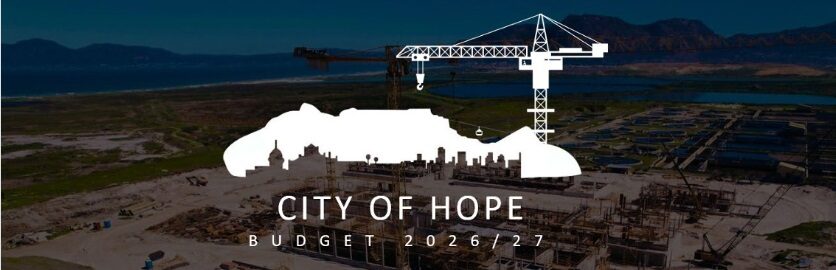

The City of Cape Town offers the most rates relief and benefits for pensioners and indigent households, based on a comparison of the tabled 2026-27 draft budgets for the big five metros. Comparing the budgets of the five biggest cities in South Africa, Cape Town offers the highest rates relief and widest pensioner and indigent benefits for each major relief category.
See the full comparison of the big five metros below:
100% rates rebate criteria for indigent households
- Cape Town – up to R620 000 property value or R7 500 monthly household income.
- Ekurhuleni – up to R7 073 household income (property value must not exceed R1,5m) OR deemed indigent (property value up to R600 000).
- eThekwini – up to R350 000 property value.
- Tshwane – up to R250 000 property value.
- Joburg – <R1 300 household income for 100% rebate, 70% available up to R7 500 (property value must not exceed R500 000).
Lifeline electricity qualifying criteria
- Cape Town – property value of R500,000 or less, monthly household income of R7,500 or less.
- Joburg – up to R7,500 income; property value must not exceed R500,000.
- Ekurhuleni – up to R7,073 income (property value must not exceed R1.5m) OR deemed indigent (property value up to R600,000).
- eThekwini – property value up to R350,000.
- Tshwane – property value up to R250,000.
Free Basic Water
- Cape Town – 15kl (up to R620k property value and/or R7 500 monthly household income).
- Joburg – 10kl (household income up to R7 500), 12kl (up to R5 000); 15kl (up to R1 300).
- Tshwane – 12kl (up to R250k property value).
- Ekurhuleni – 6kl (deemed indigents, property up to R600k) / 10kl (registered indigents, income up to R7 073).
- eThekwini – 6kl (property value up to R350k, or income up to R7 000 and property up to R750k).
Rates-free benefit
- Cape Town – first R620 000 rates-free (properties up to R8m)
- Joburg – R300 000
- Tshwane – R250 000
- Ekurhuleni – R150 000
- eThekwini – R120 000
*All amounts include the R15 000 impermissible
Pensioner benefits
| Pensioner Rates Rebate | Maximum Rates rebate | Qualifying Criteria |
| Cape Town | 100% regardless of property value, plus Lifeline electricity | R27 000 household income = 10% rebate; increasing on a sliding scale to 100% rebate for income of R10 000 or less |
| Ekurhuleni | 40 – 100% depending on income, additional R150 000 of property value rates-free if non-indigent pensioner up to R23 750 income | Household income up to R4 640 = 100% rebate, decreasing on a sliding scale to 40% rebate for income R18 900 – R23 750 |
| Tshwane | For non-indigent pensioners: 60% regardless of property value | Up to R17 499 household income |
| Joburg | 50-100% up to R1,5m property value (pensioners 60-69 years); 100% up to R2m (70+ years) | 60-69 years: 100% if Household income R13 519 or less; 50% if R23 172 or less; Over 70 years: properties up to R2m qualify for 100% rebate; |
| eThekwini | Benefit cannot exceed R5 290 per annum linked to rateable property value | Property value of R2,5m or less |
Pro-poor infrastructure investment
- Cape Town’s ‘City of Hope’ Budget draft contains a R40 billion three-year infrastructure budget – a South African record.
- By 27/28, the City’s capital budget will exceed that of all three Gauteng metros (R14,4bn combined).
- Around 130 000 construction-related jobs will flow from capital investment in the current term of office alone, with 75% of infrastructure spending directly benefitting lower-income households.
Infrastructure investment highlights over the three-year budget framework include:
- R16,7bn water and sanitation investment – 40% of total spending – including major wastewater works upgrades, quadrupled pipe replacement, and expanded water supply sources.
- R6bn in electrical grid upgrades and maintenance to prepare for a decentralised energy future with less Eskom reliance.
- R3,7bn in road maintenance, pothole repairs, upgrades to roads and stormwater, and R653m in congestion relief projects.
- A further R3,3 billion for the major MyCiTi Cape Flats expansion, the biggest of its kind in South Africa.
- R3,3bn for informal settlement upgrading and state-subsidised housing.
- A further R227m for sports facility upgrades.
- R300m for the Strandfontein Pavilion redevelopment.
The City of Hope Budget further includes an all-time record R6,8bn safety and security budget proposed for 2026-27.
Submit comments for the supplementary public participation
Supplementary public participation is open until June 10, 2026. This will allow sufficient time to adopt a budget before the financial year begins on July 01, 2026 as the law requires. The Western Cape Minister of Finance has been notified and has given approval for the amended budget adoption time-line.