
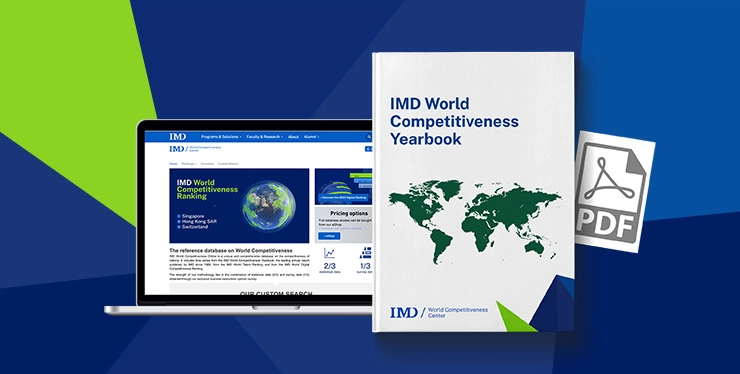

South Africa has been named as Africa’s most competitive economy in IMD World Competitiveness Centre’s 2026 World Competitiveness Yearbook. The nation has climbed 10 places above from its previous position to 54th out of 69 economies ranked at global level.
The annual ranking assesses countries across four pillars, that includes economic performance, government efficiency, business efficiency and infrastructure.
Thus, the improved performance of South Africa underscores growing competitiveness and highlights the country’s potential as a destination for investment, trade and business. For the Cape Town & Western Cape, this reinforces the continued focus on creating an enabling environment for investment, expanding export opportunities, strengthening connectivity and driving sustainable economic growth.
IMD World stated that, competitiveness of the economy cannot be reduced to its GDP, productivity or employment levels. It can be gauged only by considering a complex matrix of political, social and cultural dimensions.
Economic competitiveness is synonymous with people’s quality of life, and governments play just as important role as companies. Answering, how? why? and in what ways does the constantly evolving macro-economic landscape have an impact?
The IMD World Competitiveness Center, with its flagship World Competitiveness Ranking, has provided data for 38 years and analysis. It has taken a global, regional, sub-regional, economic, and “people” lens, using external hard data and the results of a home-grown survey of senior executives in 70 global economies.
Notably, the latest edition was released in June 2026. As South Africa obtains the 54th rank, the index has been topped by Singapore followed by Hong Kong and Switzerland on 2nd and 3rd positions respectively. Similarly, followed by Taiwan on 4th, UAE on 5th, Denmark on 6th, Ireland on 7th, Netherlands on 8th, Sweden on 9th and USA on 10th.

Director of the World Competitiveness Center – Arturo Bris said that the geopolitical conditions are worsening and global fragmentation is increasing. He added that the nations with their own tried and tested, credible institutions gain an advantage in this context because, as the international systems cease to serve so many national needs, businesses can carry on as usual.
Bris added that strong institutions are economies’ greatest buffer against economic shocks. The economies boasting credible institutions are better positioned to tackle today’s volatile and fragmented world, as the 2026 IMD World Competitiveness Ranking finds. This signals a clear shift in the drivers of competitiveness from the traditional emphasis on cost, scale and output.