
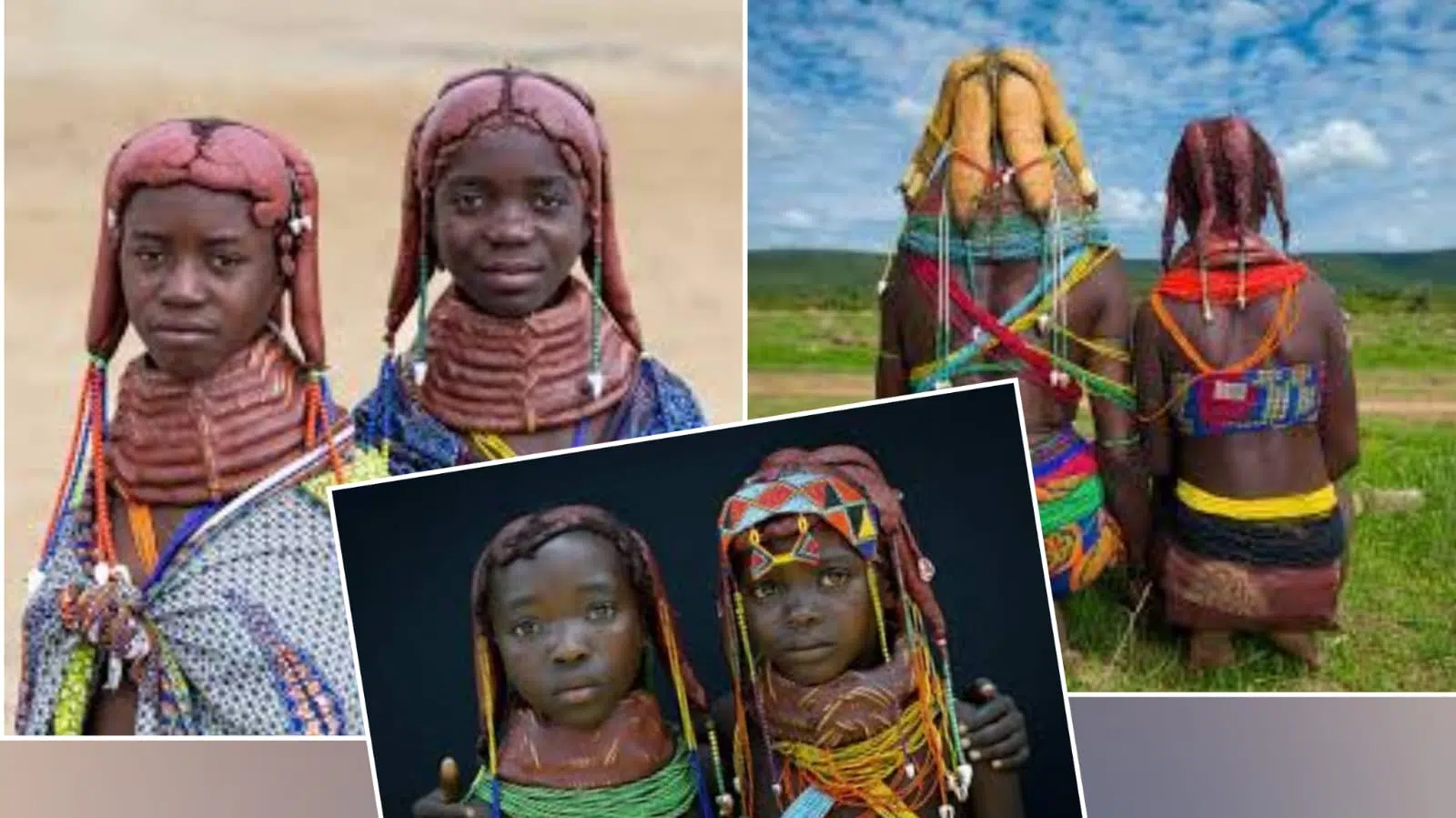

High in the hills of Huíla, where the soil is rich and red, the Mumuila people wear their culture in the most striking ways. The Mumuila highland communities are a subgroup of the Mumuila people in southern Angola in Huíla province. They maintain strong cultural traditions, with women who are recognised for their hairstyles shaped with red clay known as – ‘otjize’. The layered bead necklaces called as missangas, and leather or metal adornments.
A glance is enough to tell a story of hair shaped with clay, beads layered with meaning, and adornments that speak of identity and pride. Here, tradition isn’t something kept in the past; it lives in every detail, every day.
The red dust weaved with beads glint in the morning sun, layered missangas resting against skin like stories passed from one generation to the next. Tradition here is not preserved in silence; it is worn, shaped, and lived boldly and beautifully by the people who carry their history as art.
A video is going viral of Mumuila women in which they can be seen making a red paste and then applying it on their hair. The clip has amazed netizens and makes them ask about the thing or practice as what is this?
On searching, it was found that the unique hairstyle is known as nontombi. Women apply oncula a red paste made from crushed red stone, oil, dung, and herbs to hair styled into thick braids known as nontombi. It symbolises maturity, beauty, and group identity.
Women wear stacked, colourful bead necklaces called Vilanda (married) or Vikeka (unmarried), which are rarely removed. They use white cowrie shells, metal rings, and intricate leatherwork to adorn their hair and bodies. This look of Mumuila women’s feature shaved foreheads and deep red hair, that reflects their status within the community.
View this post on Instagram
Who are Mumuilas?
Also known as Mwila, these people are of Bantu origin and are said to be one of the earliest Bantu people to undertake the Great Bantu migration to domicile in their present location in Angola.
According to their oral tradition, they settled down in that area during the 17th century, because of a drought that made them abandon their lands in the country of Quilengues. In fact it seems Mwila are supposed to be a miscegenation of Jaga invaders. Coming from east (and who made transitory invasion in Congo), they conquered the area, with the ab-original inhabitants of the area, the Chimbemba (or Bachimba).
The conquerors have formed the powerful kingdom of Huila during the 17th century, led by a Soba, which ruled the area until the first half of the 19th century. Mwila were part of this chiefdom and most of the traditions of these Bantu cattle farmers date back to these times, although it is not clear for them nowadays.
Unlike the other ethnic groups that fled from Angola to neighbouring country, Namibia as a result of wars, drought and invasion by powerful ethnic groups, the Mwila people and their parent ethnic group Nyaneka-Humbe did not disperse outside Angola. These people culturally remain fiercely independent, a point made clear by the continuation of their fantastic dress.
The largest settlement in the region is Lubango. It became the only city in the former Portuguese colony that had a white majority at independence, because these semi-nomadic people outright refused to live there. In 1988 the Nyaneka-Humbe (the first group is also spelled Haneca; the latter group is also spelled Nkumbi) constituted 3% of the population.
Nontombi is Speciality of Mumuila Women
Mwila are not allowed to mention people’s name in public. But Mumuhuila women are especially famous for their very special hairstyles. Indeed, hairstyles are very important and meaningful in Mwila culture.
Women coat their hair with a red paste called, oncula, which is made of crushed red stone. They also put a mix of oil, crushed tree bark, dried cow dung and herbs on their hair. Besides they decorate their hair with beads, cauri shells (real or plastic ones) and even dried food.
Having their forehead shaved is considered as a sign of beauty. The plaits, which look like dreadlocks, are called nontombi and have a precise meaning. Women or girls usually have four or six nontombi, but when they only have three it means that someone died in their family.
Mumuhuila Women are also famous for their mud necklaces, which are important as for each period of their life corresponds a specific type of necklace. When they are young, girls wear heavy red necklaces, made with beads covered with a mix of soil and latex. Later girls start to wear a set of yellow necklaces called, Vikeka, made of wicker covered with earth. They keep it until their wedding, which can last 4 years.
Once married they start to wear a set of stacked up bead necklaces, called Vilanda. Women never take their necklace off and have to sleep with it. They also use headrests to protect their hairstyles.
However, more and more men and women dress in a western way, because people use to make fun of them when they go to markets.
Religion, Survival and Economy
The Mwila are traditionalist who believe in a Supreme being. They also believe that the spirits of their ancestors can either work for their good or for their worst. In order to please the ancestors animal sacrifices have to be made.
At birth a child is dedicated to a spirit by his parents. This is to “bless” and “protect” him.
They have a tribal chief who serves as the head of the tribe followed by a headman. Serving under the headman are the elders. Conflicts are resolved by the elders and the headman. A diviner is also often called upon.
Mwila people are semi-nomadic people who engage in subsistence agriculture and some form of livestock keeping. They grow mostly maize as well as other staples. They keep animals such as fowls, goat and cattle.
The Mwila people are also known for bee-keeping to extract honey which is major part of their diet. Mwila or Mumuhuila rarely eat meat, they rather eat porridge, corn, chicken, honey and milk. They kill their cattle only on special occasions.
Living conditions are tough as women sometimes walk for 50 kilometers to reach Huila market to sell goods. They trade their livestock and crops for mostly things like cloth, blankets, sugar, cornmeal, salt, and wine.
It’s strange that we still find such tribal communities who preserve their tradition and unique identity like this. The 21st century has came so far in technology and modernisation, yet there are still some sections and regions which are still unaware of these progress the world is making.