
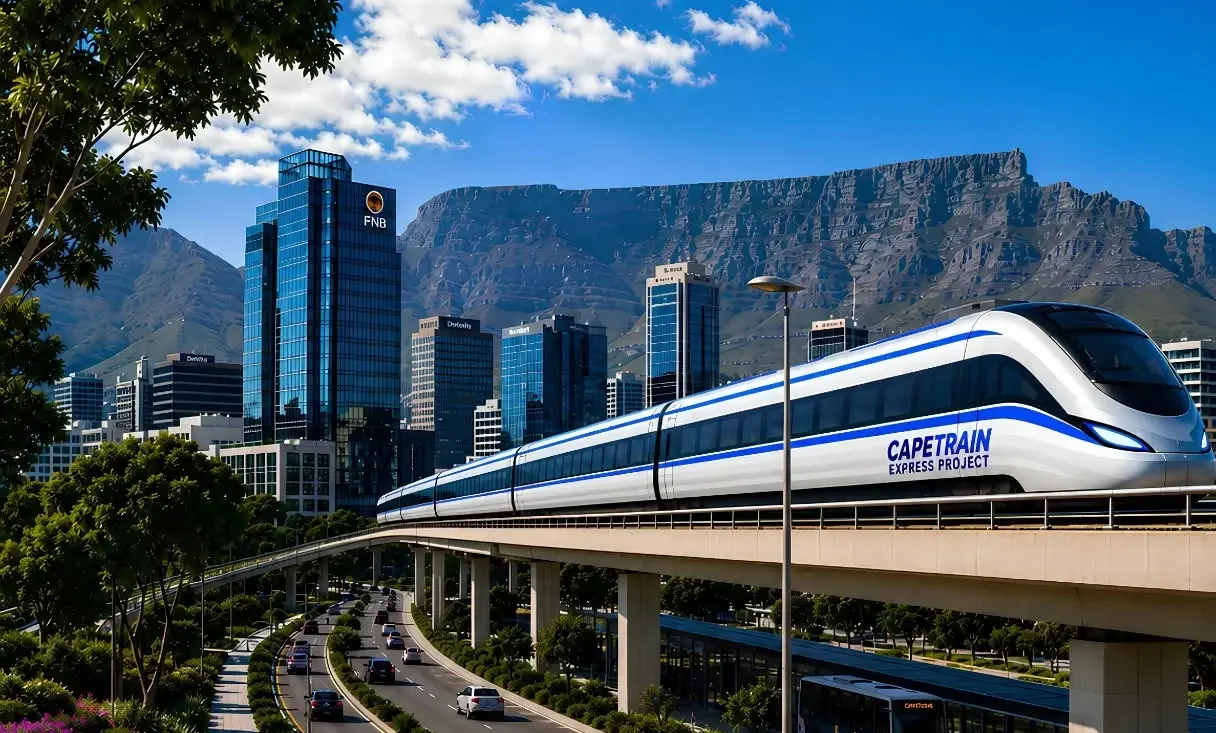

Cape Town: A proposal to complete long-unfinished Foreshore Freeways of Cape Town has come under renewed scrutiny with critics arguing that the multibillion-rand project would do little to ease traffic congestion in and around the central business district (CBD) and the Atlantic Seaboard.
According to the proposal’s supporters, decades of global evidence suggest that expanding road infrastructure encourages greater private vehicle use. It is a phenomenon known as induced demand, ultimately recreating congestion rather than eliminating it. They contend that investing heavily in car-centric infrastructure would repeat planning mistakes that many major cities are now working to reverse.
Instead, proponents are advocating for the Capetrain Express Project as a more sustainable and inclusive transport solution. The proposed initiative aims to transform the Foreshore into a high-capacity public transport corridor designed to move more people efficiently while reducing dependence on private vehicles.
Beyond improving mobility, the project is expected to unlock valuable land for mixed-use development, including housing, commercial spaces and public amenities. Supporters argue that this approach would stimulate economic growth, enhance urban regeneration and will create more accessible public spaces for residents and visitors alike.
As cities worldwide increasingly prioritise public transport, walkability and sustainable urban planning over inner-city freeways, advocates believe Cape Town has an opportunity to adopt a future-focused transport strategy that balances mobility, economic development and environmental sustainability.
Built for Speed to Counterpart Gautrain
A multimodal Capetrain Express Station within the DHL Stadium Precinct would fundamentally redefine the nature of the impact of the hosting of major events on the Atlantic Seaboard. A station here would not only make stadium operations significantly more viable but also ensure that the pipeline of present and planned developments can continue well into the future without bringing the road network to a breaking point.
The Capetrain Express will be built for speed. Like its upcountry counterpart, the Gautrain, in its race against the South African Air Force Museum’s Alouette-II helicopter, the Capetrain Express will be ready to take on the best of the best.
Will Restore Original Railway Heritage
The Capetrain Express will restore the original railway heritage of the Atlantic Seaboard in accordance with the historic 1923 Green Point Common registration. At the dawn of the 20th century a train line ran along the present-day Helen Suzman Boulevard and Beach Road, past the Sea Point Pools and onto to Queen’s Beach. This former rail-reserve is the reason the Sea Point Promenade exists today.
The proposed Capetrain Express terminus on the Three Anchor Bay Mixed-Use Development Site, would add a vital transport-oriented component to the last sizeable piece of developable land on the Atlantic Seaboard. The new terminus would provide a world-class commuter connection and economic connectivity corridor to the CBD, the extended Cape Town metro-region, Cape Town International Airport, and the new Cape Winelands Airport, while enabling present and planned development on the Atlantic Seaboard to continue well into the future.
Accommodates V&A Waterfront’s Expansion Project
The Capetrain Express will fundamentally change the way major events and road traffic impacts on the day-to-day lives of Capetonians. The system, if implemented would allow Cape Town to become a truly multi-event city that is able to operate without interrupting the daily activities and commutes of its residents.
This new additional transit capacity would comfortably accommodate the V&A Waterfront’s expansion project and other major developments in the Atlantic Seaboard. Considerably alleviating the strain on the limited road network and infrastructure well into the future.
Unlocks Tourism and Business
The Capetrain Express will unlock new tourism, business and commuter corridors across Cape Town. It will support sustainable densification, economic growth and the City’s goal to have 75% of all commuter trips using public transport by 2050.
The Capetrain Express will complement the existing rail network by reducing travel times, improving connectivity, increasing ridership and enabling Cape Town to host multiple major events without disrupting daily life. The Capetrain Express is a bold step towards faster, more affordable and more equitable access to opportunity for all.
Will re-align Metrorail Corridor
The decommissioned Athlone Power Station occupies a strategically located 40-hectare precinct at the heart of the Cape Flats, surrounded by some of Cape Town’s most densely populated communities. Positioned adjacent to the N2 and within close proximity to both the Central and Cape Flats Metrorail corridors, the site presents a unique opportunity for a major transit-oriented mixed-use development.
By integrating a Capetrain Express Station interchange with a re-aligned Metrorail corridor, the precinct could be transformed into a vibrant mobility hub supporting new housing, commercial activity, community facilities and sporting infrastructure, while sensitively preserving and repurposing the power station’s iconic industrial heritage for future generations.
Why Capetrain Express Matters
The National Rail Master Plan proposes major improvements to Cape Town’s rail network. It mainly includes trains every three minutes and over 2 million passenger journeys per day by 2052.
But there is a fundamental question; that How do we persuade millions of people to leave their cars at home if public transport offers little advantage over driving?
In 1997, Metrorail carried approximately 774,000 passenger journeys per day when Cape Town’s population was around 2.5 million people. By 2052, Cape Town’s population is projected to approach 10 million people. Yet rail ridership is expected to reach just over 2 million passenger journeys per day by that time.
This means that while the city will have nearly quadrupled in size, rail usage will increase by only around two and a half times. At the same time, many of Cape Town’s most important destinations will still lack direct rail access:
- Cape Town International Airport
- Cape Winelands Airport
- Cape Town Stadium
- Atlantic Seaboard
- CTICC & Foreshore
This is where the Capetrain Express changes the equation. Not by replacing the National Rail Master Plan, but by completing it. By connecting the city’s economic engines, tourism hubs and major destinations with fast, direct rail services.
The Capetrain Express would dramatically reduce journey times, increase ridership, unlock investment, support housing growth, and make public transport a genuinely compelling alternative to private vehicles. Because the future of Cape Town will not be determined by how many kilometres of railway we build.
It will be determined by whether we create a transport system so fast, convenient and connected that people willingly choose it. That is the opportunity. That is the challenge. That is why the Capetrain Express matters.
Future of Urban Mobility
The Capetrain Express Project is designing the future of urban mobility in Cape Town, to provide an efficient express rail network connecting people, places, and opportunity.
The Capetrain Express network will compliment and integrate with the existing Metrorail network, improving its effectiveness, reducing travel times and increasing ridership across the network, all while dismantling the barriers to opportunity and future-proofing the City for its continued economic, tourism and population growth.
A multimodal Capetrain Express transportation hub, integrated directly into the Cape Town International Airport terminal building would mean that domestic and international travellers to the Cape Town metro region would finally have access to a world-class commuter experience that is fast, reliable and convenient.
The Capetrain Express Project aims to address the enduring spatial inequalities created by apartheid-era spatial planning by improving access to opportunities irrespective of location.
By reducing commuting time and costs, the network will enhance productivity, lower household expenses, expand economic access, and improve quality of life for all. The proposed route map illustrates how the network will better connect the greater metro region, promoting accessibility, tourism, development and economic growth.